
What Organic based lawn care actually means at Life Lawn
What “Organic-Based Lawn Care” Actually Means at Life Lawn
If you research lawn care companies long enough, you start noticing that the word “organic” gets used pretty loosely.
Some companies use one organic fertilizer application a year and still market themselves as organic lawn care. Others may use natural ingredients in one part of the program while still relying heavily on traditional synthetic herbicides and fertilizers everywhere else.
One thing I realized pretty quickly while building Life Lawn was that homeowners weren’t just asking whether a lawn company used a few organic products. They were trying to figure out whether the overall philosophy of the program was actually centered around healthier soil, organic-based inputs, and safer lawn care practices.
That’s the direction we chose to take.
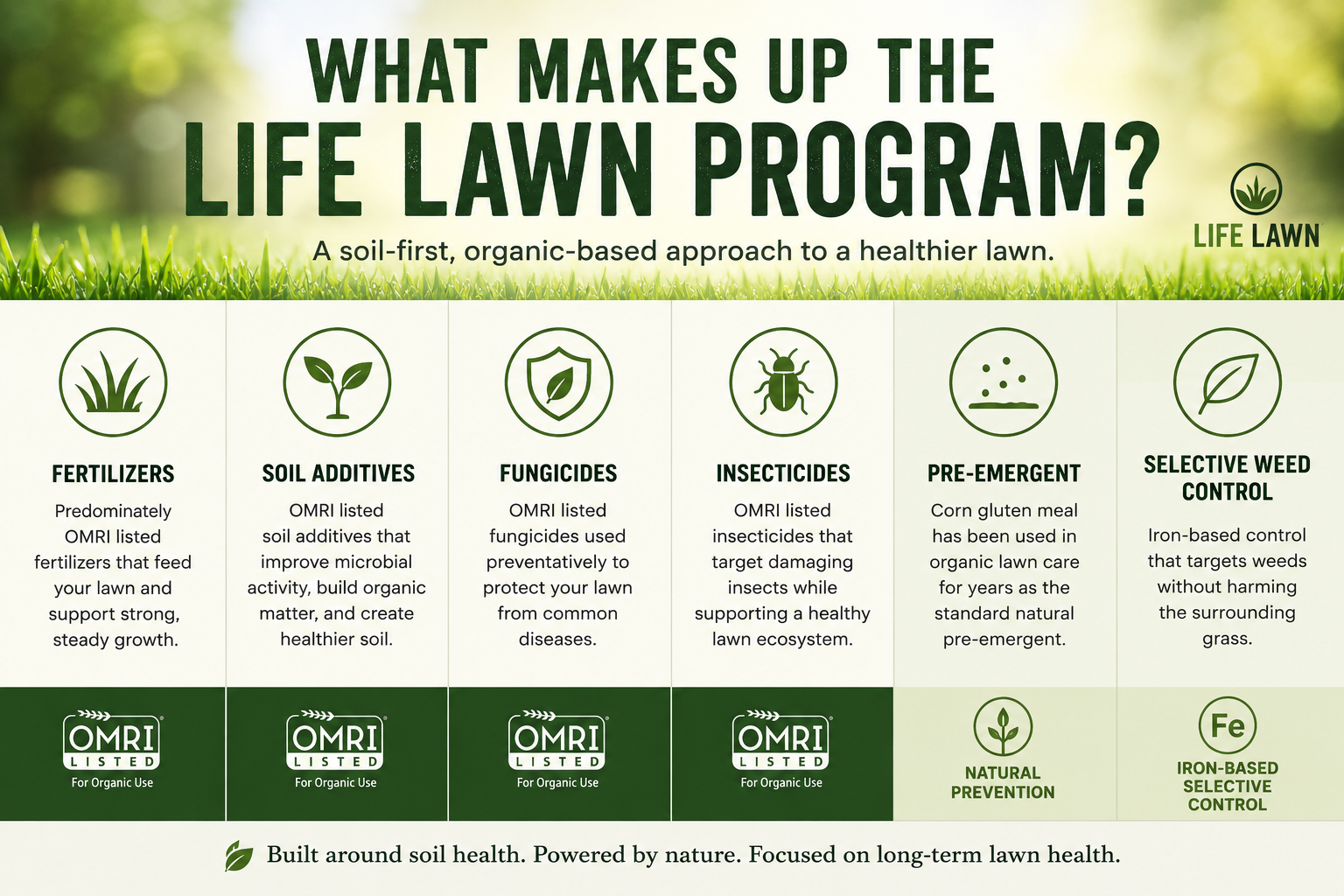
At Life Lawn, the majority of the products we use throughout our lawn program are OMRI listed or organic-based products. That includes our fertilizers, soil additives, fungicides, insecticides, and many of the inputs we use to improve turf health over time.
At the same time, we also try to be realistic and practical about lawn care. Selective weed control is one area where product selection becomes especially important in an organic-based lawn program.
I think it’s important to explain that honestly instead of pretending every product category has a perfect organic solution already available.
Why We Built the Program Around Soil Health
A lot of lawn care programs are designed around quick visual response. Fast green-up. Rapid top growth. Aggressive weed suppression.
The problem is that those results don’t always translate into healthier turf long term
Over time, I found that many lawns around Springfield, Missouri were stuck in a cycle where the lawn would temporarily improve after treatments, then decline again once heat stress, drought, disease pressure, or weed pressure returned. That’s especially common with tall fescue lawns in Midwest growing conditions.
Tall fescue can produce a beautiful lawn here, but it also deals with:
heavy summer stress
clay soils
compaction
inconsistent rainfall
fungal pressure
temperature swings
A lot of traditional lawn programs focus heavily on forcing growth above the surface while paying less attention to the condition of the soil underneath. Our approach is more focused on improving the lawn gradually from the soil upward.
That includes:
organic-based fertilization
improving microbial activity
building healthier root systems
increasing turf density
improving organic matter in the soil
reducing long-term stress on the turf
Because in most cases, thick healthy turf is one of the best natural weed prevention systems you can create.
Why We Use Predominately OMRI Listed Products
OMRI stands for the Organic Materials Review Institute. An OMRI listed product has been reviewed for compliance with organic standards and approved for use in certified organic operations. That matters because lawn care marketing can get pretty vague.
Terms like:
“green”
“natural”
“eco-friendly”
“organic-based”
can mean almost anything depending on the company using them. OMRI listing at least provides a level of outside verification about the ingredients being used. That’s why our fertilizers, soil additives, fungicides, and insecticides are built heavily around OMRI listed products whenever possible.
One thing I noticed while testing products over time is that many organic-based products tend to work more gradually and more naturally with the lawn instead of forcing extreme surges of growth.
The lawn response often looks steadier. Root development tends to improve. Soil structure improves. Turf density improves.
That’s the type of long-term improvement we’re trying to create.
Corn Gluten Meal Has Been the Standard Organic Pre-Emergent for Years
One misconception people sometimes have is that organic lawn care means you simply allow weeds to take over. That’s obviously not the goal. A healthy lawn program still needs weed prevention.
One thing I realized pretty quickly is that pre-emergent weed control actually wasn’t the hardest part of building an organic-based lawn program. Corn gluten meal has been used in organic lawn care for a long time and is widely accepted as the standard organic approach for helping suppress weed germination.
It’s not technically OMRI listed itself, but within the organic lawn care world, it has been used for years as the primary natural pre-emergent option.
That’s an important distinction.
Traditional synthetic pre-emergents work by creating chemical barriers that prevent seed germination. Corn gluten meal works differently, but it still plays an important role in reducing weed pressure while contributing organic matter and nitrogen to the lawn.
Over time, I found that combining corn gluten meal with thicker turf development created a much more complete strategy.
Because the reality is this: Most weeds thrive in thin turf. If the lawn is weak, compacted, stressed, or sparse, weeds naturally move into those open areas.
A dense lawn changes the entire equation.
Selective Weed Control Was the Most Difficult Part to Solve
One thing I realized pretty quickly while building an organic-based lawn program was that pre-emergent weed prevention actually wasn’t the hardest part. The more difficult challenge was selective weed control after weeds had already emerged.
A lot of natural weed control products on the market work by burning or dehydrating plant tissue using ingredients like citric acids, sodium, soaps, or strong plant oils. While those products can kill weeds, many of them also damage the surrounding grass at the same time. That becomes a bigger issue with tall fescue lawns here in Springfield because tall fescue does not aggressively spread and repair itself the way bermuda grass does. If the surrounding turf becomes weakened, weeds often move right back into those thin areas again.
Over time, I started looking for an approach that stayed aligned with the overall philosophy of the program while still allowing us to selectively target weeds without constantly injuring the lawn itself.
Why We Use an Iron-Based Selective Weed Control Product
After a lot of testing and research, we decided to use an iron-based selective weed control product within the program. The active ingredient is chelated iron. Iron is already naturally present in soil, plants, food, vitamins, and even the human body. In this case, the iron is bonded to an amino acid to improve stability and absorption so it can work effectively as a selective weed control.
That distinction mattered to us.
Instead of relying on conventional herbicides like 2,4-D, glyphosate, or dicamba, we chose an approach built around iron chemistry because it aligned much more closely with the type of lawn program we wanted to build.
One thing I noticed during testing was that this approach allowed us to target many broadleaf weeds without causing the same level of collateral stress to the surrounding turf that many non-selective organic products created.
While the product itself is not OMRI listed, the iron-based approach aligned closely with the overall philosophy of our program, which focuses on soil health, organic-based lawn inputs, and avoiding traditional synthetic herbicide programs.
Why We Don’t Promise Instant “Perfect” Lawns
One thing I try to explain clearly to homeowners is that healthier lawns are usually built over time.
Especially if the lawn already has:
compaction
weak turf density
poor soil conditions
heavy weed pressure
disease stress
years of harsh treatment cycles
A lot of lawns around Springfield didn’t become unhealthy overnight. Rebuilding them usually doesn’t happen overnight either. Our focus is on gradually improving the lawn system as a whole so the turf becomes stronger and more resilient naturally.
That often means:
stronger root systems
thicker turf
reduced weed pressure over time
improved stress tolerance
healthier soil activity
more stable lawn performance through Midwest weather swings
Sometimes the improvements are dramatic in the first season. Sometimes they’re more gradual. But the long-term direction matters more to us than chasing temporary cosmetic response.
Why This Matters for Families and Pets
One of the biggest reasons people contact Life Lawn is because they want a lawn care approach that feels safer and more aligned with how they use their yard. Kids playing barefoot. Dogs laying in the grass. Families spending evenings outside during summer.
That’s a major reason why we intentionally built the program around predominately OMRI listed fertilizers, soil additives, fungicides, and insecticides while avoiding traditional synthetic herbicide programs.
The goal was never to create a marketing label. The goal was to build a lawn program that made practical sense long term for both the lawn itself and the families using it.
Final Thoughts
At the end of the day, we built Life Lawn around a pretty simple idea:
Healthier lawns start with healthier soil. That philosophy influences every part of our program, from the fertilizers and soil additives we use to our approach toward weed control, turf density, and long-term lawn improvement.
We intentionally built Life Lawn around:
soil health
organic-based fertilization
OMRI listed lawn inputs
no traditional synthetic herbicides
healthier turf density
long-term lawn improvement
If you’re looking for organic-based lawn care in Springfield, Missouri and want to learn more about how we approach fertilization, weed control, soil improvement, and tall fescue lawn health, you can browse our FAQ page or explore more articles on the Life Lawn blog.